
Creative expression for processing dementia
We all have the capacity to express our feelings in creative ways that help us process emotions. David Taylor and Terry Marshall are caregivers and musicians who share how they found comfort in creative expression.
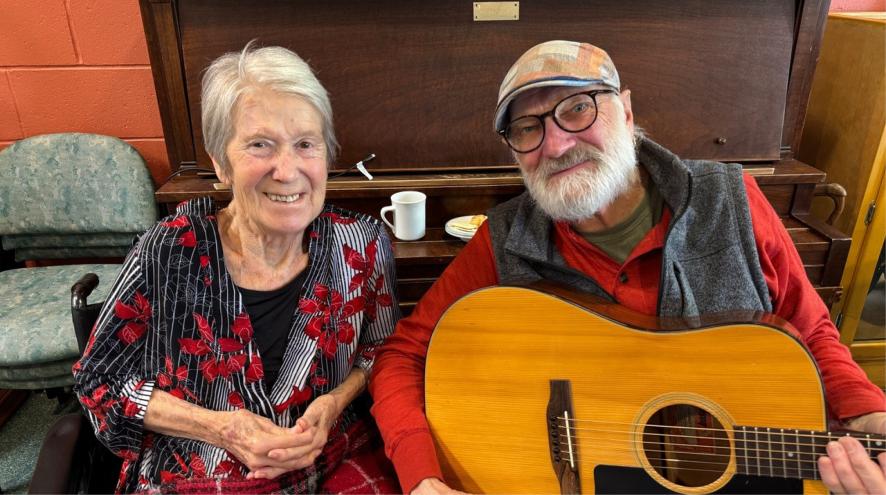
David J. Taylor and Terry Marshall are musicians and caregivers who have found comfort in creative expression.

David, a record producer and songwriter, has faced difficult times throughout his caregiving journey. During his husband Russ’s prolonged hospital stay, the realization Russ was never coming home hit hard. Being in limbo between hospital and long-term care was a dark place for the couple. While at Russ’s bedside, David found himself repeating the words, “It’s not forever, just for now.”
These words would become the lyrics to an original song that he’d been wanting to re-write for decades. It reflects the feelings of a person caring for another transitioning through a difficult time. They are words David was repeating earlier this year.
Like others finding creative expression assists with life challenges, David experienced a needed emotional release in writing and recording this song as his husband of 29 years was transitioning from hospital into 24-hour care. “[The song] wrote itself in seven minutes, but it took 23 years for it to be the song it needed to be,” David says.
David reflects on the deep loss they experienced and acknowledges he couldn’t tell Russ that it was going to be okay, because it wasn’t okay. Everything was changing.
“We [were] we,” he says, “And now suddenly I’m an individual trying to find a way forward.” The song captures a caregiver’s dilemma of wanting to offer reassurance in the face of so many unknowns. David hopes his song provides comfort to others. “If anyone else who is going through this journey can benefit, that’s awesome,” David says,” That’s ultimately what music and art should do — it should affect you.”
Writing has allowed him to enter what feels like “a spiritual place” disconnected temporarily from painful realities. Playing the song for others, including his peers in his caregiver support group, is something David says is “so therapeutic.” Through the difficult moments, music has supported him as a care partner in taking care of his own well-being.
For Terry and his wife Janet, music has always been at the heart of their 45-year marriage. They played in a band together, and their love for folk music and performing took them around the world.
“We were life partners and musical partners,” says Terry. “Music was a passport for us to experience, really, the best of life”.
Following a devastating fall six years ago that brought on both physical and cognitive decline, Janet could no longer play the instruments she loved, but she continued to connect and find joy in singing. Despite the challenges, music remained a constant.
When Janet moved to a long-term care home, the couple continued performing together, holding a weekly concert for the other residents and staff and posting their performances on their popular YouTube channel. The music connected them to each other and kept Terry resilient.
On April 2, Janet passed away in what Terry described as a “very peaceful transition.” Their love for music remained a cherished bond right till the very end as he sang Shenandoah by her bedside. When asked what he hopes others will take away from their musical journey, Terry shares, “I want others to know that no matter what life throws your way you have the ability to carry on.”
If you are a care partner who hasn’t yet found the value of creative expression, here are a few reasons to try:
- To give a voice to hard-to-name emotions. Identifying feelings helps with accepting and responding to them. The experience of dementia is complex, particularly for care partners seeing ongoing changes.
- To distance yourself from difficult emotions. A work of art such as a poem or song can hold grief and allow the sadness to be expressed without needing to retell difficult specifics or feel overwhelmed.
- To make meaning of the changes that have happened. Rather than trying to restore losses, care partners can reflect on experiences and appreciate what remains, holding both grief and connection.
- To support processing and long-term integration of grief. Because a person can be living with dementia for an extended period of time, many care partners face ambiguous loss and anticipatory grief. Creative expression offers a way to mourn at times when grief seems unexpected or misunderstood.
We are not all musicians, visual artists or writers, but we all have the capacity to express our feelings in creative ways that help us to process emotions.
To listen to David J. Taylor’s song, It’s not forever, just for now, visit alzbc.org/davidJTaylor.
For Terry & Janet Marshall’s YouTube channel visit youtube.com/@terrymarshall123.
Would you like to share your experience to the music? Tell us here! Email us at [email protected].