
Nonverbal Communication Tips
Learn practical strategies for communicating effectively, including how to connect with someone who has limited or no verbal communication.
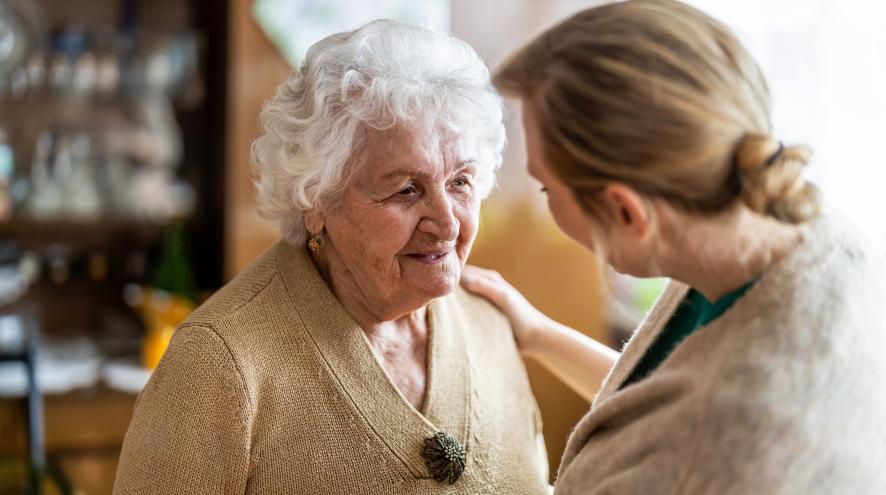
As a person lives with dementia, they will begin to experience changes in the ways they express themselves and in understanding what is communicated to them. Some common changes to communication a person living with dementia may experience are:
- Difficulty finding a word.
- Creating new words for ones that are forgotten.
- Repeating a word or phrase (perseveration).
- Difficulty organizing words into logical sentences.
- Cursing or using other offensive language.
- Reverting to the language that was first learned and talking less than usual
As the condition progresses, the person living with dementia may become non-verbal, communicating largely through gesture and sounds. Research shows ongoing communication with and to non-verbal individuals is beneficial to their quality of life and wellbeing.
So, how can you adapt your communication style to continue engaging a person living with dementia as they become non-verbal?
Body Language and Facial Expressions
As people living with dementia lose their ability to communicate verbally, they will begin to rely more on their ability to interpret the body language and facial expressions of those communicating with them. They will also come to communicate more through their own body language and facial expressions.
Here are a few practical tips on how to adapt your body language and facial expressions to improve your community:
- Approach the person living with dementia with a relaxed demeanor. Shoulders and arms relaxed, a calm expression, gentle movements.
- If an interaction becomes tense or stressful step away, if you are able, to recenter and calm yourself.
- Maintain open body language, avoiding postures that close you off like crossing your arms or clenching your fists.
- Place yourself at eye level with the person living with dementia and make eye contact.
- Do not cover or obscure your mouth while speaking.
- Use your facial expressions to connect with the person living with dementia and create a sense of safety, a simple smile or a wink after a joke can create a strong connection and help to convey your tone.
Tone and Cadence
Have you ever heard the expression "It's not what you say, it's how you say it."? Well, when it comes to talking to a non-verbal communicator, this is especially true. As dementia progresses, people living with it will gradually lose the ability to understand the words you are saying and instead will derive meaning from the way that you say them.
If you speak too quickly, they may assume you're in a hurry and don't have time for them. If you raise your voice or speak aggressively, they may assume you're angry, even if you're delivering a positive message.
How can you adapt your tone and cadence to improve your communication?
- Focus on speaking slowly but clearly and keeping your tone upbeat (when appropriate) or at least relaxed and neutral.
Connecting Through Touch
One of the most straightforward ways to foster connection - when verbal communication is not possible - is through physical touch. Establishing a physical connection through touch can be grounding, comforting, reassuring, and convey a sense of comradery and emotional connection. Holding or shaking hands, patting shoulders, or embracing can be great ways to connect through touch.
How can you connect through touch to improve your communication?
- Alert the person that you are going to touch them before you do and pay attention to their facial expressions and body language to gage how they feel about the touch.
- If their demeanor changes (if they seem to become agitated or upset) after the initial contact, it's best to back off.
- People living with dementia are still individuals with preferences and feelings, respect their autonomy and adapt your use of touch based on their needs and perceived comfort.
- As references and interests can shift as people live with dementia, so it’s important to pay attention to how someone reacts in the moment rather than assuming based on past preferences.
Visuals and Gestures
Incorporating visuals and gestures into your communication can help you communicate more clearly. As dementia progresses, words and their meanings can become harder to recall. By adding gestures and visual cues, you can decrease the burden of language processing on the person living with dementia.
Additionally, being aware of and able to interpret gestures and visuals used by the person living with dementia can help improve your ability to understand them and make it easier for them to communicate with you.
How can you add visuals and gestures into your communication?
- Mime actions or activities as you talk about them (i.e. asking if they would like you to brush their hair and pretending to brush your own or inviting them to join you on a walk and walking in place briefly).
- Point at things you are discussing, for example if you are asking them to join you in another room point in the direction you want them to go.
- Employ labels, cue cards, picture books, or apps specifically designed for people living with dementia and their care partners to improve communication.
- Australias Centre for Cultural Diversity in Ageing offers a series of communication cards available in 74 languages
Talking to Yourself
When we consider communicating with non-verbal individuals, we may encounter discomfort at the idea of "talking to ourselves" - engaging the individual in a "one sided" conversation where we “hold the floor” and the other person does not respond verbally. It is important to sit with and challenge this discomfort.
These conversations can be great at building a connection with a person living with dementia and can increase their sense of safety with you. Carrying out these conversations can be especially beneficial during daily tasks such as bathing as verbally walking the person through the task you’re doing can be both distracting and soothing.
What can you talk about when you’re talking to yourself?
- Your day.
- Family and friends.
- Past shared memories.
- The weather.
- Any topic the person has an interest in.
References: Non-Verbal Communication in Dementia Care, Making a Connection: Your Guide to Non Verbal Communication with Dementia Patients, ASC Communication