
Giving Back While Moving Forward: Kim’s Story
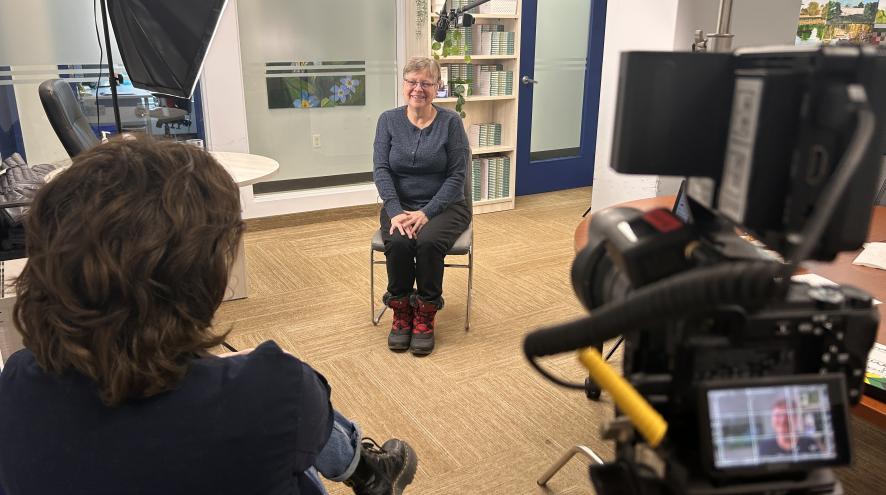
It was while working as a psychologist at Dalhousie University that Kim first noticed she was becoming more forgetful. She approached her family doctor and was given the MoCA test, an assessment tool for early detection of Mild Cognitive Impairment (MCI).
Kim will never forget what the doctor said when he explained her results. “He said I did okay but not as well as he thought I would, given my level of education,” she said. “That really stuck with me. On one hand, it was validating, and on the other, it was a little bit scary.”
Kim carried on with life until the day she became lost in an area she knew well. That’s when she knew something was wrong and returned to her family doctor. He referred her to a gerontologist and she was diagnosed with Mild Cognitive Impairment in 2024.
“I was devastated at first and felt like my life was over, but I quickly realized that I had a chance to make the best of the life I had left.” That’s when she reached out to the Alzheimer Society’s Dementia Helpline. “Making that call felt like opening a huge door—and I had no idea just how many opportunities it would lead to.”
Not only has Kim benefitted from the support that’s been offered to her, she has quickly made herself invaluable as a volunteer. She’s on the Advisory Committee of People with Lived Experience, serves at a monthly social group, and has given her time at annual events, such as the Walk for Alzheimer’s and the Early Stage Forum.
“My whole career was in the helping profession so it just made sense to volunteer and use the skills that I have,” she says. “I know that my symptoms could one day progress into full dementia, so I want to make good use of the time I have now.”
Making good use of her time is something Kim has always excelled at, following her passions into all kinds of adventures. Throughout her life, she’s published a book, worked as a photographer, been a member of a women’s barbershop chorus, and served as a director of membership and philanthropy for a large international organization. She’s also been a commanding officer of an air cadet squadron, worked as a commissioner on Halifax’s waterfront, and appeared as a background actor in film (check out the very first episode of Sullivan’s Crossing to catch sight of her!)
Having Mild Cognitive Impairment hasn’t slowed Kim down; it’s just changed some of the things she does with her time. “A diagnosis doesn’t mean your life is over and it doesn’t have to hold you back,” she says. “I’m as active as I am now because of the diagnosis, not despite of it.”
One of the biggest changes for Kim was her decision to stop driving. “That was a tough one,” she says. “Driving for me was synonymous with freedom and independence.” But in her typical glass-half-full fashion, Kim has found a silver lining. “I’m learning how to take the bus and I’m also walking a lot more,” she says, adding that it was more empowering to give up her own license than to have it taken away or to have injured another person in a car accident.
Kim knows first hand that dementia is a challenging journey and one that can be hard to accept “But,” she says, “acceptance is what helps us move forward, make the best use of our time, and accomplish the goals and dreams we still have.”
She spends a great deal of time these days encouraging those with MCI or dementia to reach out and get help early in their diagnosis. “It’s been important to me to share my experience, while I’m still able to do so, in the hope that it might benefit others,” she says. “If I can help even one other person reach out and get support early in their journey then all my efforts are worth it."