
Marsha’s Weather
In his latest short story, Tobias reflects on the realities of caregiving. Marsha’s Weather invites readers to embrace uncertainty, reminding us that sometimes the most compassionate response is simply to stay present.
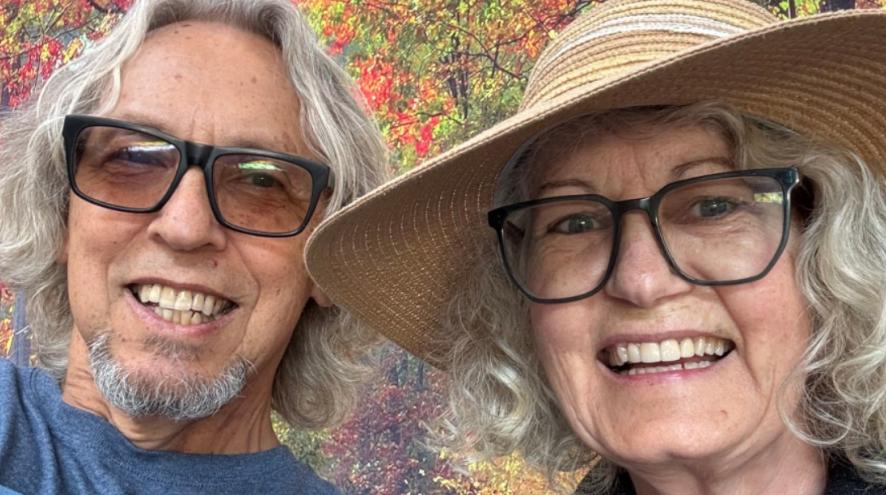
Marsha does not experience her days as a story with a beginning, a middle an end. Dementia changed that. She shows her inner life to the world differently now. It is simpler and – in its own way – truer. Watching her is like watching the weather — present, total and sometimes unpredictable. At times, a fog coming in on cat’s feet sitting quietly on the ground of her being, at times, a storm of emotions, mostly, a sunny disposition of kindness.
On a quiet afternoon, her husband was talking, his voice choked, unsteady, giving her a quiet accounting of their 44 years together as he often does. How Marsha is a model mom. How the kids are succeeding. How lucky they are as a couple. How much he loves her. Marsha can’t tell you the story of those four decades if you ask but something in her doesn’t need the story. Some older, wordless part of her was still fully awake, still listening from deep in the brain and without warning, her tears were falling.
There was a time when her husband would have seen those tears and would reached for an explanation: tears mean sadness, something is wrong, fix it. But he has slowly learned that it isn’t that simple anymore. For over 40 years, tending to his feelings had been etched into her like a pathway her body will never forget, long after the words for it are gone. Maybe her tears are that old devotion, still finding its way to the surface. Or maybe, she was just catching the feeling in the room the way you’d catch a tune, his emotion becoming hers.
Underneath it all sat something else, not an illness, not a diagnosis, just a quiet, permanent kind of ache that had nothing urgent about it. Like mist. It doesn’t need a reason to be there. It’s just weather in a valley they both know well.
This time, he didn’t rush to name it. He didn’t ask himself whether this was joy, sadness, frustration or something to worry about. He’d learned over years of experience to sit inside the not-knowing and not-being-able instead of solving his way out of it. His mantra now, “to be able to not be able.” So, he just stayed. He took her hand. He let the weather move through the room without trying to change its course.
That’s how it goes now. When Marsha cries, he checks that she isn’t in physical distress. He doesn’t search for a psychological explanation or try to analyze it – that’s something for later, when there is time to reflect and write. Instead, he sits close. He holds her hand. He stays with her in the experience. Sometimes he asks gently, “What’s there?” More often, he simply watches: quiet, patient, the way they might watch mist drift across a valley they have loved for a long time. He has learned, though, not to mirror her tears, which only makes the weather worse. His tears are for later – for a private moment, often at night, quietly into his pillow.
♪ It’s dementia and she’ll cry if she wants to. You can cry too if it happens to you. ♪
Postscript: Trying to change dementia was like trying to control the weather for me but I eventually learned to do what I could i.e.; put on a raincoat or sweater, acting from inside and what I could control, my mood. Writing has helped this process immensely and as a mathematician/computer scientist by training, I would never have tried but for encouragement to journal from others.
Thanks to Carl Sandburg and his poem “Fog” and Byung Chul Han and his concept “Being able to not be able.” Also, Wally Gold, John Gluck Jr., Herb Weiner, Seymour Gottlieb the songwriting team for “It’s My Party.”
About the author
Tobias and his wife, Marsha, have navigated the challenges of life, including raising three fine adults and Marsha's dementia. Tobias approaches this journey with love, patience and joy. At age 70, he continues to embrace the lifelong journey of becoming a better person, finding inspiration and wisdom in Marsha's daily teachings. Tobias states, Marsha teaches me as much now, as ever before, and the lessons while hard are humbling and rewarding.